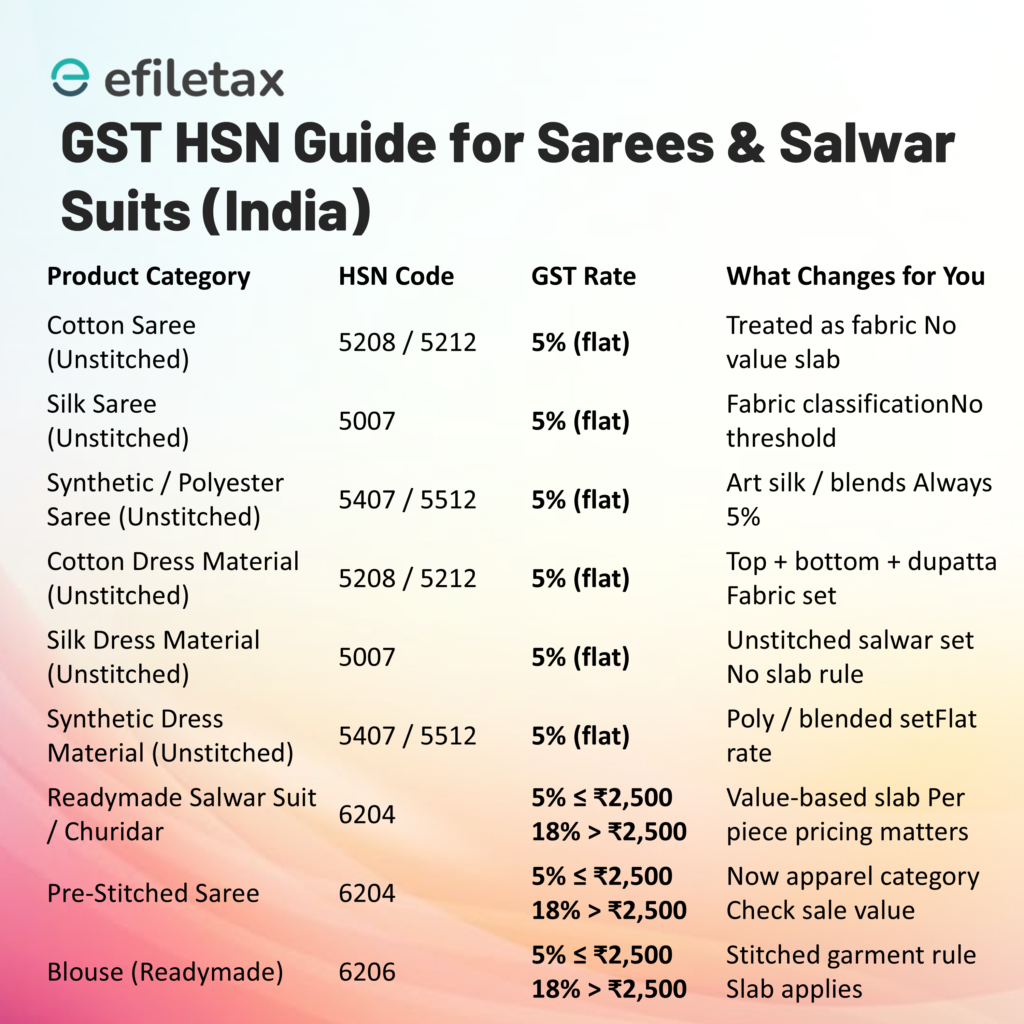
GST on Sarees & Salwar Suits in India (2025): 5% or 18%? Don’t Make This Costly Mistake
If you sell sarees or salwar suits in India, one small GST classification error can wipe out your margin.
Most boutique owners, online sellers, and even accountants confuse one simple rule:
Unstitched = Fabric
Stitched = Garment
And that single difference decides whether you pay 5% or 18% GST.
Let’s break this down clearly.
The Big Question: Is It Stitched?
Under GST, the tax rate on sarees and salwar suits does not depend only on price. It depends first on structure.
If the product is unstitched fabric → It is taxed as fabric.
If it is stitched and wearable → It becomes apparel.
This shift changes both HSN code and GST rate.
GST on Unstitched Sarees (Fabric Category)
Traditional sarees sold as drape fabric are treated as textile fabric, not garments.
HSN Codes Based on Material:
Cotton saree → 5208 / 5212
Silk saree → 5007
Polyester saree → 5407
Synthetic / blended saree → 5512
GST Rate:
5% flat rate
There is no ₹2,500 limit for unstitched sarees.
Even if a silk saree is sold for ₹25,000, GST remains 5% because it is classified as fabric.
Common Mistake:
Many sellers wrongly assume expensive sarees attract 18%. That slab does not apply to unstitched sarees.
GST on Unstitched Dress Material (Salwar Sets)
If you sell:
Top fabric
Bottom fabric
Dupatta fabric
And none of it is stitched, it is still fabric.
HSN Codes:
Cotton dress material → 5208 / 5212
Silk dress material → 5007
Synthetic dress material → 5407 / 5512
GST Rate:
5% flat, no value limit.
Important:
Even if sold as a complete set, it is not treated as apparel unless stitched.
When GST Jumps to 18%: Stitched Products
The moment the product is stitched and wearable, GST rules change.
It now falls under ready-made garments.
HSN Codes:
Readymade salwar suit → 6204
Readymade churidar → 6204
Pre-stitched saree → 6204
Readymade blouse → 6206
GST Rate (Value-Based Slab):
5% if sale value per piece ≤ ₹2,500
18% if sale value per piece > ₹2,500
This ₹2,500 rule applies per piece, not per invoice.
Example:
One stitched suit sold at ₹2,600 → 18% GST
Two stitched suits sold at ₹2,400 each → 5% GST per piece
This is where many brands make billing errors.
Pre-Stitched Saree: The Most Misclassified Product
A normal saree (unstitched) → 5% flat
A pre-stitched saree (ready-to-wear) → treated as garment
HSN: 6204
GST: 5% or 18% depending on ₹2,500 threshold
This single difference has triggered GST notices for many boutique owners.
Why Correct HSN Code Matters
Wrong HSN or GST rate can result in:
Short payment of GST
Interest liability
Penalty
GST scrutiny or notice
ITC mismatch issues
For D2C brands and Instagram boutiques, this can become a serious compliance risk.
For Brands Like “Laced with Grace”
If you sell both:
Unstitched sarees → 5%
Stitched blouses → 5% / 18%
You must:
Apply GST separately per item
Use correct HSN code on invoice
Configure accounting software correctly
Check per-piece sale value
You cannot apply one flat rate across all products.
Quick Compliance Checklist Before Filing GSTR-1
Ask yourself:
Is this stitched or unstitched?
What is the correct HSN code?
Is the per-piece value above ₹2,500?
Have I applied correct GST slab?
Does invoice description clearly match product type?
This 5-minute check can prevent a costly GST notice.
Final Takeaway: One Stitch Can Change Your GST
In the textile business, GST does not depend only on fabric type or price.
It depends on:
Fabric vs Garment
HSN classification
₹2,500 per-piece value
If it is unstitched → 5% flat.
If it is stitched → check ₹2,500 slab.
Before you upload your next product or issue your next invoice, verify classification once.
Because under GST, one stitch can cost you 13% extra tax.