
When you sell a residential property in India, the profit, referred to as capital gains, is taxable under the Income Tax Act. However, Section 54 offers an opportunity to significantly reduce or eliminate this tax burden if you reinvest the proceeds into another residential property. Here’s a detailed guide on the key provisions, eligibility, and recent updates regarding Section 54 exemption
Key Conditions of Section 54 Exemption
1. Eligibility
This exemption is available to individuals and Hindu Undivided Families (HUFs) who sell a residential property classified as a long-term capital asset, meaning it has been held for more than 24 months.
2. Investment in New Property
- Purchase Timeline: The new residential property must be purchased within one year before or two years after the sale of the original property.
- Construction Option: If constructing a new property, the completion must occur within three years from the date of sale.
3. Location of Property
The new property must be located in India. Properties purchased or constructed abroad are ineligible for this exemption.
4. Number of Properties
- Exemption typically applies to the purchase of one property.
- For capital gains not exceeding ₹2 crore, taxpayers have a one-time option to invest in two properties. This lifetime option ensures flexibility but can be used only once.
5. Exemption Amount
The exemption amount is determined as the lower of:
- The capital gains amount, or
- The investment made in the new residential property.
Important Update: As per the Finance Act 2023, the maximum exemption under Section 54 is capped at ₹10 crore.
6. Capital Gains Account Scheme (CGAS)
If the capital gains are not reinvested before the due date for filing the income tax return, the unutilized amount must be deposited in a Capital Gains Account Scheme (CGAS). The deposited amount must be utilized within the specified timelines to retain the exemption.
7. Holding Period of New Property
The newly acquired property must be held for at least three years. If sold earlier, the exemption will be revoked, and the capital gains will be treated as short-term capital gains, attracting a higher tax rate.
How Section 54 Works
Suppose Ms. B sells her residential property, earning a long-term capital gain of ₹75 lakh. She invests ₹50 lakh in a new residential property within the stipulated time. Here’s the breakdown:
- Exempted LTCG: ₹50 lakh (amount reinvested in the new property).
- Taxable LTCG: ₹25 lakh (remaining amount).
If Ms. B deposits the unutilized ₹25 lakh into a CGAS account before the ITR filing due date, she retains the option to reinvest it later.
Additional Insights
1. Multiple Exemptions
If part of the capital gains remains unutilized under Section 54, taxpayers can explore Section 54EC, which allows investments in specified bonds to claim additional exemptions. The investment limit in such bonds is capped at ₹50 lakh.
2. Recent Amendments
The Finance Act 2023 introduced several changes, including the ₹10 crore cap on exemptions and clarifications on eligibility. Staying updated with tax laws or consulting a professional is essential for compliance.
3. Lifetime Benefits
The two-property option for gains up to ₹2 crore can be exercised only once in a lifetime, making it crucial to plan wisely before availing of this provision.
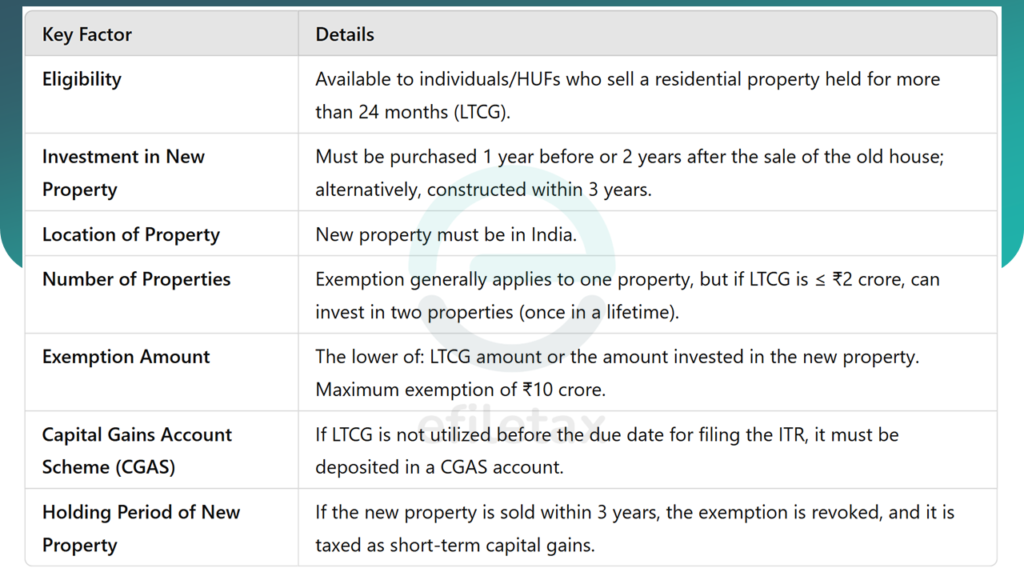
Simplified Overview of Section 54 Exemption
| Key Factor | Details |
|---|---|
| Eligibility | Individuals/HUFs selling a long-term residential property (held >24 months). |
| Investment Timeline | Purchase within 1 year before or 2 years after; construct within 3 years. |
| Property Location | New property must be in India. |
| Number of Properties | One property; two properties if LTCG ≤ ₹2 crore (lifetime option). |
| Exemption Cap | ₹10 crore (applicable from April 2023). |
| CGAS Requirement | Deposit unutilized LTCG into a CGAS account before ITR due date. |
| Holding Period | Retain new property for at least 3 years to avoid revocation. |
Navigating tax laws can be complex, but planning your investments strategically can lead to significant savings. If you’ve recently sold a residential property or plan to, efiletax can help you manage your taxes efficiently and make the most of available exemptions.
Let’s simplify your taxes—contact us today for expert guidance!