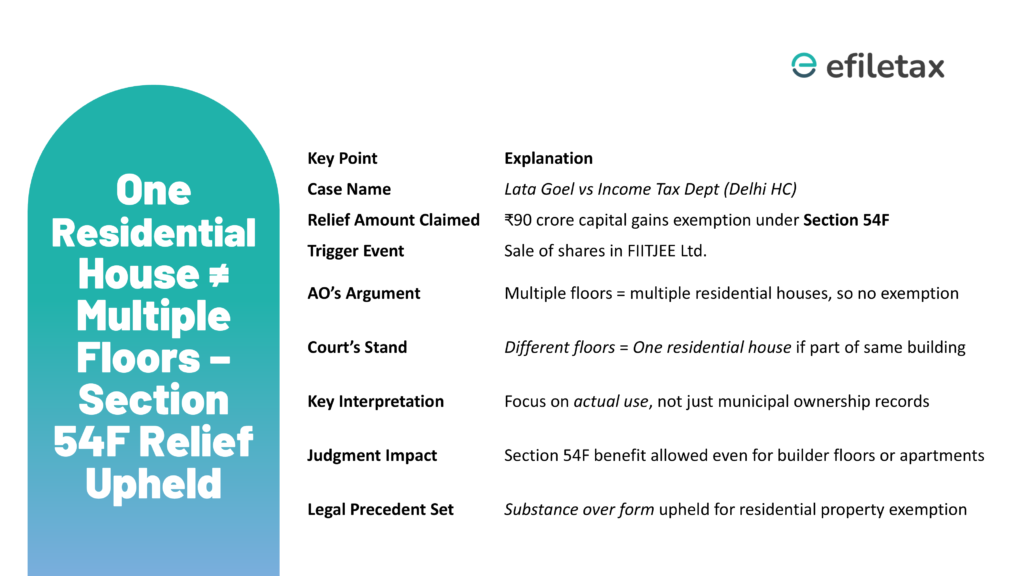
Capital gains exemption under Section 54F has long been debated—especially when the reinvested property has multiple floors. A recent Delhi High Court ruling has now cleared the air: different floors of a single residential house do not disqualify a taxpayer from claiming the full exemption.
Delhi HC clarifies that multiple floors of a single house don’t disqualify a taxpayer from claiming capital gains exemption under Section 54F. The judgment in favour of Lata Goel sets a precedent and simplifies the “one residential house” condition for capital gains reinvestments.
🔍 What Was the Case?
- Assessee: Lata Goel, wife of FIITJEE promoter
- Sale Transaction: Shares of FIITJEE Ltd. worth ₹90 crore
- Claim: Exemption under Section 54F for reinvestment in residential property
- AO’s Stand: Denied full exemption, citing multiple floors = multiple houses
- Court’s Verdict: All floors = one house = full exemption allowed
🏠 What Does Section 54F Say?
Under Section 54F of the Income Tax Act, if you sell a long-term capital asset (not a residential house) and reinvest the entire net consideration into one residential house in India, you can claim exemption from capital gains tax.
Key Conditions:
- You shouldn’t own more than one residential house on the date of transfer
- You must buy or construct a new house within 2/3 years
- Full exemption only if entire sale proceeds are reinvested
⚖️ What Did the Delhi High Court Decide?
- One House ≠ One Floor: The court held that multiple floors in a building used as a single residential unit should be treated as one house.
- Municipal Records ≠ Tax Interpretation: Just because SDMC records list different floors, doesn’t mean they are separate residential houses for income tax purposes.
- Disclosure Was Honest: The assessee had clearly disclosed the transaction and reinvestment. No intent to hide.
📜 Legal Takeaways
| Issue | Court’s Finding |
|---|---|
| Ownership of multiple floors | Still qualifies as “one residential house” |
| SDMC showing different units | Not sufficient to deny exemption |
| Honest disclosure by taxpayer | Strengthens the claim under Section 54F |
| AO’s reassessment | Overruled based on facts and legal clarity |
“The ruling is a clear application of the principle of substance over form,”
“This will help many genuine taxpayers whose properties are structured across floors but function as a single unit. The Delhi HC judgment sets a strong precedent.”
✅ What Should You Do?
If you’re planning to reinvest capital gains:
- Ensure actual usage of the house aligns with single residential use
- Keep documentation clear about unit configuration
- Don’t rely solely on municipal records—substance matters more
- Make full disclosure in your ITR
📌 Quick Recap Who Can Benefit from This Judgment?
- Taxpayers selling non-residential assets (e.g., shares)
- Planning to reinvest in one residential house
- Property structured across multiple floors but used as one unit
- Facing scrutiny based on property records
❓ FAQ on Section 54F and Multi-Floor Homes
Q1: Can I claim 54F if I buy a duplex?
Yes, as long as it’s used as a single house.
Q2: What if municipal records show separate units?
Courts look at actual use, not just how it’s recorded.
Q3: Will this help in ongoing reassessments?
Yes. This HC ruling can be cited as legal precedent.
📣 Need Help Claiming 54F Exemption?
Let Efiletax handle your capital gains filing.
Accurate. Timely. Legally Compliant.
👉 Talk to Our Experts Today